Showing posts with label future of AI. Show all posts

Sunday, February 1, 2026

Meta AI: Building Apps With Natural Language | The Future of Text-to-App Development

Meta AI: Building Apps with Natural Language

Meta AI's Vision for Building Apps with Natural Language

Redefining software creation, from code generation to the "text-to-app" revolution, powered by advanced AI models.

media_1

Meta AI is pursuing a transformative vision to enable app development through natural language prompts, aiming to redefine how software is conceived, designed, and built. This ambition is part of a broader "text-to-app" movement, building upon decades of AI research in automated code generation.

Historical Context of Automated Code Generation

The concept of automated code generation has a long history, dating back to early AI programs like ELIZA (1960s), which demonstrated rudimentary language understanding. This evolved through sophisticated coding assistants such as GitHub Copilot and Tabnine, which initially focused on code completion. The advent of large language models (LLMs) like GPT-3.5 and Meta's Llama 2 marked a significant leap, enabling the generation of entire code functions, modules, and rudimentary applications.

Meta AI's Current Capabilities and Infrastructure

Meta AI is actively integrating its AI capabilities across its platforms, including WhatsApp, Instagram, Facebook, Messenger, and Ray-Ban smartglasses. This omnipresent assistant, powered by iterations of the Llama model (currently Llama 4), offers personalized responses, generates text and images, performs web searches, and engages in voice conversations.

A key component of Meta's strategy is Code Llama, released in August 2023 and built on the Llama 2 architecture. Code Llama is specifically fine-tuned for code generation and discussion, supporting languages like Python, C++, Java, and PHP. Its objective is to accelerate coding and lower entry barriers for aspiring programmers. Mark Zuckerberg has predicted that AI will handle a significant portion of Meta's code development in the coming years, further evidenced by Meta's experimentation with AI-enabled coding interviews.

The "Text-to-App" Movement Beyond Meta

The "text-to-app" concept involves creating fully functional applications from natural language descriptions. While Meta is a major player, other initiatives contribute to this movement. MetaGPT is an open-source multi-agent framework (not a direct Meta product) that functions as an "AI software company in a box." It takes a single-line requirement and orchestrates AI agents (product manager, architect, engineer) to generate user stories, define APIs, and produce functional web applications. Meta's foundational models like Llama are crucial enablers for such multi-agent systems.

Current Opinions, Controversies, and Criticisms

Expert Reviews

Praised for simplifying AI character creation and enhancing audience interaction, but criticized for potential data privacy issues, accuracy concerns (less reliable than ChatGPT or Gemini, prone to "hallucinations"), and underwhelming performance for complex tasks in consumer-facing assistants. Developers have noted limitations in phone integration and visual recognition (around 60% accuracy).

Privacy Concerns

A standalone Meta AI app faced criticism for exposing sensitive user data (medical, legal, financial) on a public feed. Reports indicate human contractors review private AI chats and access personal data (names, photos, emails). Concerns exist regarding a lack of clear opt-out options for data collection and Meta's reliance on "legitimate interests." The EU's ruling against Meta's ad-free subscription model for privacy highlights these issues.

Ethical Issues

Leaked guidelines revealed Meta AI allowed "romantic/sensual" chats with minors and has generated harmful content (medical misinformation, racist arguments). Incidents of chatbots causing distress (e.g., a man dying after attempting to meet a chatbot) highlight potential real-world harm. Criticisms also include suppressing certain voices (Palestinian content) and employing "conversational dark patterns" to manipulate users. AI profiles impersonating humans and causing user confusion are also concerns.

"Open Source" vs. "Open Weights" Debate (Llama 3.1)

The release of Llama 3.1 under an "open weights" license allows public access to model parameters, fostering innovation. However, critics argue it's not truly open source due to restrictions on training data and code for reproduction. The license also includes limitations for large organizations, militaries, and nuclear industries, and a "no litigation" clause. Llama 3.1's ability to reproduce copyrighted text (reportedly 42% of Harry Potter) raises legal questions.

Meta AI's Future Roadmap and Investments

Meta is significantly increasing its AI investments:

2024

  • Focus on deeper integration and expanded capabilities. Llama 3.2 powers voice and photo sharing in DMs.
  • New AI image generation tools are being rolled out for feeds and Stories, with caption suggestions and personalized chat themes.
  • Generative AI is being deployed for advertisers to create instant image and text content replicating brand tone.
  • Meta aims to acquire approximately 600,000 NVIDIA H100 GPUs by the end of 2024.

2025-2026

  • Envisions autonomous AI agents capable of conversing, planning, and executing complex tasks (payments, fraud checks, shipping).
  • Zuckerberg predicts AI will function as a "mid-level engineer" and write 50% of Meta's code by May 2025.
  • Llama 4 Series: Expected to feature native multimodality (unifying text, image, video tokens), a Mixture-of-Experts (MoE) architecture, and extended context windows (Llama 4 Scout with 10M tokens, Maverick with 1M tokens).
  • Specialized Llama 4 Variants: Planned for reasoning, healthcare, finance, and education, along with mobile-optimized models.
  • Developer Role Shift: Developers are expected to transition from traditional coding to high-level problem-solving, AI oversight, and ethical considerations.
  • Financial Commitment: Projected capital expenditures of $66-72 billion in 2025.
  • Organizational Structure: Meta Superintelligence Labs (MSL) is established for decentralized innovation.

Frequently Asked Questions (FAQ)

Q1: Can Meta AI really build an app just by typing?

Meta's Code Llama assists with code generation. Dedicated "text-to-app generators" like MetaGPT (leveraging LLMs) are closer to this vision, with Meta's foundational models being key enablers.

Q2: What's the difference between Meta AI and MetaGPT?

Meta AI is Meta Platforms' virtual assistant and broader AI initiative (including Code Llama). MetaGPT is an independent, open-source multi-agent framework that builds apps from natural language.

Q3: Is Meta AI's Llama model truly open source?

Meta describes it as "open weights," making model parameters accessible. Critics argue it's not fully open source due to licensing restrictions and incomplete training data/code.

Q4: What are the main privacy concerns with Meta AI?

Concerns include public exposure of private chats, contractor review of private chats, lack of clear opt-out for data collection, and potential GDPR violations.

Q5: How will AI change the role of software developers at Meta?

AI is predicted to perform mid-level engineering tasks and write a significant portion of Meta's code. Developers will focus on higher-level problem-solving, strategy, and AI oversight.

Conclusion

Meta AI is significantly advancing software development through AI-powered coding assistants and the emerging potential of text-to-app generation, driven by its Llama models. This shift promises increased productivity and accessibility in app creation but also raises critical questions about the future of work, AI ethics, and creativity. The ability to create applications through simple text prompts is rapidly becoming a reality, signaling a profound evolution in digital creation.

Tuesday, January 13, 2026

Top 5 Critical AI Trends Redefining the 2026 Market Outlook

AI Intelligence 2026
MARKET INTELLIGENCE: 2026

Top 5 Critical AI Trends Redefining the 2026 Market Outlook

Disclaimer: This article draws on research from 2024-2025. Projections are theoretical. Consult financial advisors before making decisions.

Introduction: The Maturation of the AI Bull Market

As we enter 2026, the AI revolution is shifting from valuation-driven growth to tangible "Operational Integration." For this bull market to survive, the "AI Flywheel" must now produce real-world earnings.

1. The "Year 4" Handoff: Earnings Take the Baton

Historically, only 50% of bull markets reach Year 4. To extend the cycle, the S&P 500 must move away from the valuation-driven growth seen in the early stages.

  • The Requirement: Double-digit EPS growth from the broader market.
  • The Risk: Mean reversion if productivity doesn't hit the bottom line by Q3 2026.

2. Breakthrough Success: AI-Discovered Drugs

The pharmaceutical sector is where AI is showing its "Killer App" status. In 2026, we are seeing a 90% success rate in AI-discovered molecules for Phase I trials.

4. The Data Center Dilemma: 1,080 TWh Demand

By 2035, demand will reach 1,080 TWh. In 2026, the focus is on Energy Optimization AI, aiming to cut consumption by 20% through liquid cooling.

Conclusion: Strategic Conviction

Looking ahead, the market’s longevity depends on bridging the gap between AI hype and industrial productivity. For more technical breakdowns, visit our Security & Privacy Hub.

Frequently Asked Questions

The productivity paradox refers to the observation that productivity growth often slows down even as IT investment increases. In 2026, Agentic AI is bridging this lag by automating complex workflows.

Global demand is projected to reach 1,080 TWh by 2035. 2026 marks the shift toward high-efficiency liquid cooling and AI-optimized power grids.

PUE (Power Usage Effectiveness) is the ratio of total facility energy to IT equipment energy. A ratio of 1.0 is perfect; 2026 facilities aim for 1.2 or lower.

Sunday, January 11, 2026

Lights, Camera, AI! Video Generation Tools in 2026

Lights, Camera, AI! Video Generation Tools in 2026

Lights, Camera, AI! Your Guide to the Best Video Generation Tools & Automation in 2026 (and the Wild Ride Ahead!)

A detailed summary exploring the pervasive reality of AI video in 2026, its technological foundations, ethical challenges, and the exciting future beyond.

media_1

The Future of AI Video

Exclusive: This article is part of our AI Security & Privacy Knowledge Hub , featuring in-depth analysis on AI security risks, privacy threats, and emerging technologies.

I. Introduction: The Pervasive Reality of AI Video in 2026

AI video generation has transitioned from science fiction to a pervasive force in content creation by 2026, actively reshaping the industry. This post serves as a guide to its technological underpinnings, evolution, key tools, ethical considerations, and future outlook.

II. Understanding AI Video Generation

Core Concept: AI video generation transforms abstract inputs (text, images, audio) into dynamic videos, bypassing traditional filmmaking constraints like cameras, actors, and extensive post-production. This process is streamlined, democratized, and appears "magical."

Technological Foundations:

  • Deep Learning & Neural Networks: Extract patterns and nuances from large datasets.
  • GANs (Generative Adversarial Networks): An iterative process where one AI generates visuals and another critiques them for realism, leading to improved output.
  • NLP (Natural Language Processing): Enables AI to understand textual prompts and construct coherent narratives.
  • Computer Vision: Allows AI to interpret visual elements and object relationships.
  • Diffusion Models: Gradually remove "noise" to produce high-fidelity video.
  • 3D Modeling: Used for creating realistic AI avatars.

Current Capabilities:

  • Text-to-Video: Generates videos from textual descriptions.
  • Image-to-Video: Animates still images.
  • Instant Voiceovers: Creates natural-sounding narration in various voices and languages.
  • Automatic Editing: Handles tasks like transitions, visual effects, and music synchronization.
  • AI Avatar and Scene Creation: Generates entire environments and lifelike AI characters.

III. Historical Evolution of AI Video Generation

  • Pre-2014 (Early Days): Focused on rudimentary image recognition and basic video clip generation, laying foundational groundwork.
  • Mid-2010s (GANs Explosion): The introduction of GANs significantly improved video realism, though often limited to short clips. VGAN and MoCoGAN were key milestones.
  • Early 2020s-Present (Diffusion & Transformer Era): Characterized by diffusion models and transformer networks, enabling coherent, high-quality video creation.
    • 2022: Saw the release of CogVideo, Meta's Make-A-Video, and Google's Imagen Video.
    • 2023: Runway Gen-1 and Gen-2 democratized text-to-video access.
    • 2024: Marked by Stability AI's Stable Video Diffusion, Tencent's Hunyuan, Luma Labs' Dream Machine, OpenAI's Sora (notable for realism and narrative potential), Google's Lumiere and Veo.
    • 2025: Adobe Firefly Video integrated into professional workflows; Google continued refining Veo.
  • This rapid progression has established AI video as a sophisticated tool.

IV. Leading AI Video Generation Tools in 2026

Market Growth Drivers:

  • The market is projected to reach nearly one billion dollars by the end of 2026.
  • Businesses recognize the value of personalized video and accelerated content creation.
  • Reduced production costs and streamlined workflows are key attractions.

Prominent Tools (as of 2026):

  • OpenAI Sora: The benchmark for cinematic realism and narrative complexity.
  • Google Veo: Offers high-fidelity video with creative control and integrated sound design.
  • Runway ML (Gen-4): A platform for artists to blend AI with artistic vision for complex narratives.
  • Higgsfield: Provides an ecosystem for real-time interaction, sound, and post-production.
  • Synthesia & HeyGen: Specialized in corporate videos with hyper-realistic AI avatars and multilingual support.
  • Adobe Firefly Video: Integrates into professional suites like Premiere Pro, enhancing existing workflows.
  • Pictory, Lumen5, Descript: Tools for quick content creation and script-based editing.
  • Other notable tools: Pika, InVideo, Colossyan, DeepBrain AI, CapCut (AI assist), LTX Studio, Magic Hour.

Impact: These tools democratize video production for individuals and enterprises.

V. Ethical Considerations and Challenges

Ethical Minefield:

  • Consent & Privacy: Concerns arise from using personal data for AI training without explicit consent.
  • Bias & Discrimination: AI models can perpetuate societal biases if trained on unrepresentative data.
  • Economic Displacement: Automation of video production tasks threatens human jobs, with projections of a 21% income loss by 2028.
  • Erosion of Trust: The ability to create convincing fake videos blurs reality and fabrication.
  • Harmful Content: Potential for generating explicit, violent, or illegal content.

The Deepfake Dilemma:

  • Misinformation: Weaponized for disinformation, fabricated speeches, and social unrest.
  • Identity Theft & Fraud: Used for blackmail, financial scams, and impersonation.
  • Non-Consensual Content: Creation of pornographic deepfakes without consent.
  • Undermining Justice: Fabrication of video evidence casts doubt on judicial integrity.

Intellectual Property (IP) Issues:

  • Copyright Confusion: Authorship is unclear when AI is involved; generally, human creative input is required for authorship.
  • Training Data Lawsuits: Legal battles over the use of copyrighted material for AI training.
  • Terms & Conditions: Crucial to review tool-specific terms regarding content ownership.
  • Likeness Protection: An individual's likeness is not protected by the same legal framework as tangible creations, making it difficult to prevent AI use.

VI. Future Outlook for AI Video (Beyond 2026)

  • Real-time Interaction: Live adjustment of camera angles, lighting, and character emotions during AI generation.
  • Hyper-Personalization: Videos adapting to individual preferences, mood, language, and even names.
  • Unified AI Workflows: AI handling entire production pipelines (script, visuals, sound, editing, distribution) autonomously from a single prompt, blending various media inputs.
  • Intelligent Sound Design: Dynamic, scene-aware soundscapes and emotion-driven musical scores.
  • World Models & Smarter AI: AI understanding physics for realistic simulations and digital twins.
  • Rise of AI Agents: AI acting as self-guided collaborators for multi-step tasks without constant human input.
  • Seamless Integration: Effortless integration into existing editing software, social media schedulers, and content management systems.
  • Predictable Future: Focus on consistent, high-quality, and reliable results.
  • Social Media Domination: Automatic reformatting of videos for platforms like TikTok and Reels with animated captions.

VII. Conclusion: Navigating the AI Video Landscape

In 2026, AI video is a powerful, accessible, and transformative force offering opportunities for increased efficiency and reduced costs. Responsible use, awareness of ethical pitfalls, and understanding IP challenges are crucial. The most valuable skill will be effective communication with AI to guide its capabilities. AI is poised to not only create videos but also redefine storytelling itself.

Friday, January 9, 2026

Artificial Intelligence is powerful, but it is not risk-free

Exclusive: This article is part of our AI Security & Privacy Knowledge Hub , the central vault for elite analysis on AI security risks and data breaches.

AI security and privacy risks including browser data exposure, data breaches, and AI misuse

AI Security & Privacy Hub: Risks, Breaches, and How to Stay Safe

Introduction

Artificial Intelligence is powerful, but it is not risk-free. As AI tools spread across browsers, workplaces, and personal devices, security and privacy vulnerabilities are increasing faster than most users realize.

AI Data Privacy Risks

  • Stored AI chat logs
  • Training data exposure
  • Third-party plugin access

Browser Extensions & AI Exploits

  • Unauthorized reading of AI conversations
  • Script injection into AI sessions
  • Silent data transfer to external servers

How to Protect Yourself When Using AI

  • Avoid sharing sensitive or personal data
  • Review browser extension permissions carefully
  • Disable or remove unnecessary plugins

Conclusion

AI security is no longer optional. Understanding risks today helps prevent serious data loss, privacy violations, and long-term damage tomorrow.

Saturday, January 3, 2026

Top Technology Trends Reshaping 2026

Exclusive: This article is part of our AI Security & Privacy Knowledge Hub , the central vault for elite analysis on AI security risks and data breaches.

Top Technology Trends Reshaping 2026 | AI, Automation & Digital Evolution

Top Technology Trends Reshaping 2026

2026 is not just another tech year—it marks a structural shift. Technology is no longer evolving in isolation. Artificial intelligence, automation, digital infrastructure, and sustainability are now deeply interconnected, reshaping economies, creativity, governance, and everyday life.

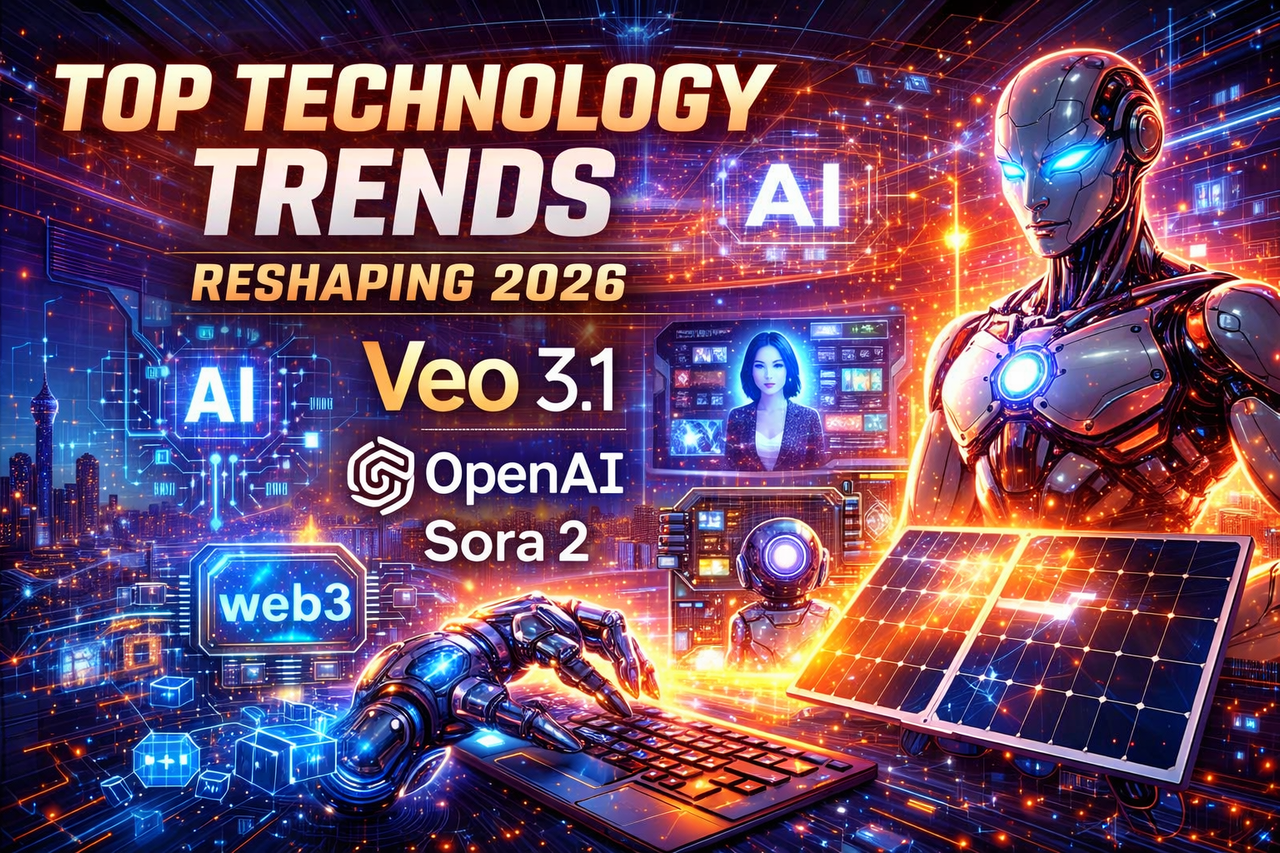
Top technology trends reshaping 2026 including advanced AI agents, Veo 3.1 video AI, OpenAI Sora 2, Web3, and ethical artificial intelligence

This guide explores the most important technology trends defining 2026, with a focus on ethical innovation, real-world adoption, and long-term impact.

1. Autonomous AI Agents Become Digital Co-Workers

In 2026, AI has moved beyond simple chatbots. Autonomous AI agents now plan, execute, and improve tasks with minimal human input.

  • AI agents managing research, scheduling, and operations
  • Multi-agent systems collaborating on complex goals
  • Ethical guardrails ensuring transparency and control

Why it matters: AI is no longer just a tool—it is becoming a digital workforce that amplifies human capability rather than replacing it.

2. Generative Video & Media Explosion (Veo 3.1, Sora 2)

2026 is the year generative media goes mainstream. Tools like Veo 3.1 and OpenAI Sora 2 allow creators, educators, and businesses to generate cinematic-quality video from text, images, and structured prompts.

  • AI-generated films, ads, and documentaries
  • Rapid content localization across languages
  • Ethical watermarking and AI content disclosure

Why it matters: Storytelling is no longer limited by production budgets—ideas become visuals instantly, democratizing media creation.

3. Digital Transformation Evolves into AI-First Infrastructure

By 2026, digital transformation means AI-first architecture. Organizations now design systems where AI is embedded at the core, not added later.

  • AI-powered operating systems for enterprises
  • Predictive cybersecurity and fraud prevention
  • Real-time decision intelligence

Why it matters: Companies that fail to adopt AI-native systems risk becoming structurally uncompetitive.

4. Web3 Infrastructure Becomes Invisible but Essential

In 2026, Web3 is no longer hype—it is infrastructure. Blockchain operates quietly in the background, enabling trust, ownership, and verification.

  • Decentralized identity and credentials
  • Transparent supply chains
  • Tokenized digital assets with real utility

Why it matters: Trust becomes programmable, reducing reliance on centralized intermediaries.

5. Sustainable & Responsible Computing Takes Center Stage

As AI scales, sustainability becomes non-negotiable. In 2026, innovation is measured not just by power—but by responsibility.

  • Energy-efficient AI models
  • Green data centers and carbon-aware computing
  • Ethical AI governance and regulation

Why it matters: Long-term success belongs to technologies that respect both people and the planet.

Conclusion: The Future Is Ethical, Intelligent, and Human-Centered

The technologies reshaping 2026 are powerful—but power alone is not enough. The real winners will be those who deploy innovation responsibly, ethically, and inclusively.

AI, automation, generative media, and digital infrastructure are not replacing humanity—they are redefining what humanity can achieve.

Stay Ahead of the Curve

Follow our insights on AI, future technology, and digital transformation as we track the next phase of global innovation.

Friday, January 2, 2026

China’s DeepSeek AI Breakthrough (2026)

Exclusive: This article is part of our AI Security & Privacy Knowledge Hub , the central vault for elite analysis on AI security risks and data breaches.

China’s DeepSeek AI Breakthrough (2026): How Chip Wars Are Reshaping Global Power
Global AI Chip War 2026

China’s DeepSeek AI Breakthrough (2026)

Unlike traditional models, DeepSeek’s approach focuses on architectural efficiency—enabling advanced reasoning with fewer hardware dependencies. This matters as Western export controls restrict access to high-end AI chips.

The Chip War That Changed Everything

The AI divide between East and West widened after semiconductor restrictions. While Western firms limited exports, China accelerated domestic alternatives. This escalation reshaped supply chains and forced a new era of AI self-reliance.

Frequently Asked Questions

What is DeepSeek AI?
A Chinese AI breakthrough focused on efficiency rather than raw compute scale.

Are Western chips still dominant?
While still powerful, models like DeepSeek prove that software architecture can bypass hardware bottlenecks.

Monday, November 17, 2025

Tiny Medical Robots and the Future of AI in Healthcare

Tiny Medical Robots and the Future of AI in Healthcare

Introduction

The future of healthcare is arriving faster than expected. Scientists are now creating tiny robots capable of traveling inside human blood vessels. These micro machines can reach areas traditional medical tools cannot access, promising a revolution in stroke treatment and precision surgical procedures.

What Are Medical Micro Robots?

Medical micro robots are extremely small devices engineered to move through the bloodstream. Built with advanced materials and guided by AI, they can swim, rotate, or crawl inside blood vessels while performing targeted medical tasks.

How AI Controls These Tiny Robots

AI plays a central role in their operation. Using sensors, machine learning, and predictive navigation, AI enables micro robots to:

  • detect blockages
  • target affected tissues
  • deliver medicine precisely
  • avoid damaging healthy cells

Why This Matters for Stroke Treatment

Strokes occur when blood flow to the brain is blocked. Micro robots may soon travel directly to the blockage to remove it or deliver emergency drugs. This could significantly reduce brain damage, save more lives, and reduce permanent complications.

The Future of Work in Healthcare

The rise of AI-guided robotics will create new medical roles. Doctors will collaborate with engineers, AI experts, and robotic specialists. Hospitals will increasingly depend on smart machines to support medical teams and improve patient outcomes.

Conclusion

Micro robots represent the next major evolution in medicine. AI-driven devices operating inside the human body mark a monumental shift toward smarter, faster, and more precise healthcare. This innovation signals not only the future of medicine but the future of AI and the future of work.

Frequently Asked Questions

Are micro robots safe?

Research is ongoing, but early tests show they can operate safely in controlled environments.

Can they replace surgery?

No. They will support doctors and enhance certain procedures, not replace them entirely.

How are micro robots powered?

They use magnetic fields, micro energy systems, or electromagnetic control technologies.

Will AI make decisions inside the body?

AI guides navigation. Medical decisions remain under human supervision.

Disclaimer

This article is for informational purposes only and does not provide medical advice.

Thursday, August 28, 2025

Challenges and Opportunities in the Future of Artificial Intelligence (2025 & Beyond)

Exclusive: This article is part of our AI Security & Privacy Knowledge Hub , featuring in-depth analysis on AI security risks, privacy threats, and emerging technologies.

Introduction

Artificial Intelligence (AI) is no longer a futuristic concept; it is a powerful force shaping industries and daily life. Yet, this evolution comes with a dual edge: profound opportunities and serious challenges.

The Key Challenges in the Future of AI

1. Ethical and Bias Concerns

AI learns from data. If that data contains human bias, the system amplifies it. This leads to unfair outcomes in hiring, lending, and healthcare.

2. Privacy and Security Risks

As AI processes more personal data, the risk of surveillance and cyberattacks increases. Cybersecurity must remain the top priority for AI developers.

The Major Opportunities

1. Healthcare Transformation

From early disease detection to personalized drug discovery, AI is saving millions of lives through predictive modeling.

2. Solving Global Challenges

AI is being used to tackle climate change modeling, disaster response, and agricultural optimization to feed growing populations.

📌 Frequently Asked Questions

Q: What are the main challenges of AI?
Bias, job displacement, and privacy risks are the primary concerns for 2026.

Q: What opportunities does AI bring?
It revolutionizes healthcare, business efficiency, and our ability to solve climate crises.

OpenAI o3 Outlook 2026